
You are using an out of date browser. It may not display this or other websites correctly.
You should upgrade or use an alternative browser.
You should upgrade or use an alternative browser.
Keyonte George’s Star Ascension
- Thread starter Elizah Huge
- Start date

Tom Pitt
Well-Known Member
Don't know if it's intentional or not, but I don't think we need bad statistical arguments to glaze Key. No need to pull a Locke.
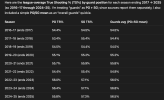 having the highest usage on the team and being clearly above average TS% is a pretty big deal. that was always Don's issue. He couldnever quite get above league average but the truly great players always do. Not saying Key is a great player. He'll have to sustain it year in and year out. But it is a positive sign being in the 60s at age 22.
Donovan never became anything more than a moderate foul drawerView attachment 19831having the highest usage on the team and being clearly above average TS% is a pretty big deal. that was always Don's issue. He couldnever quite get above league average but the truly great players always do. Not saying Key is a great player. He'll have to sustain it year in and year out. But it is a positive sign being in the 60s at age 22.
View attachment 19831having the highest usage on the team and being clearly above average TS% is a pretty big deal. that was always Don's issue. He couldnever quite get above league average but the truly great players always do. Not saying Key is a great player. He'll have to sustain it year in and year out. But it is a positive sign being in the 60s at age 22.
Kudos for brining up the fact that TS% has increased since then. Numbers have gone up quite a bit in just a few years. I see so many people comparing today’s efficiency to a previous time and that’s just not right. Key is still more efficient in a relative sense, but it’s not as much as it appears on the surface.
But the elephant in the room with all of this is the other side of the ball. I think Key is comparable or maybe even better than Don offensively, but if we’re going to call one player overrated it’s only fair to consider both sides of the ball.
Tom Pitt
Well-Known Member
yeah I wonder how much the uptick in efficiency is related to how the game is being officiated. I'd have to do a deep diveKudos for brining up the fact that TS% has increased since then. Numbers have gone up quite a bit in just a few years. I see so many people comparing today’s efficiency to a previous time and that’s just not right. Key is still more efficient in a relative sense, but it’s not as much as it appears on the surface.
But the elephant in the room with all of this is the other side of the ball. I think Key is comparable or maybe even better than Don offensively, but if we’re going to call one player overrated it’s only fair to consider both sides of the ball.

IIRC in the 90s it was around 54/55. I was curious a couple years ago and during prime Stockton years he was averaging around 65% which was top 10-15 all time I think. I wish he would have shot the ball more.yeah I wonder how much the uptick in efficiency is related to how the game is being officiated. I'd have to do a deep dive
yeah I wonder how much the uptick in efficiency is related to how the game is being officiated. I'd have to do a deep dive
I think Key is one of the biggest benefactors of the uptick in FT’s. I hate that it’s called this way, but if this going to be the way it is might as well take advantage. He’s made other improvements, of course, but he really has the perfect set of skills to take advantage. I thought he had a chance to be very, very good offensively but this is beyond what I imagined.
Defensively is where it looks really bad on paper. Some of it can be attributed to the weirdness of our situation and numbers being noisy to begin with….but I still think it’s fairly alarming.
I think going from the worst defender to like bottom 25 percentile is doable, however, and that will make a big difference.
So far his on man defense from 15 ft and beyond has shown tremendous improvement from last year, and his effort has shown it too. Last year his opponent shot a few % higher than league average and this year it is -1.5ish. His inside d #s are way worse. Likely because not having Kessler behind him makes it harder to play tight as you don't have great backup in the paint.I think Key is one of the biggest benefactors of the uptick in FT’s. I hate that it’s called this way, but if this going to be the way it is might as well take advantage. He’s made other improvements, of course, but he really has the perfect set of skills to take advantage. I thought he had a chance to be very, very good offensively but this is beyond what I imagined.
Defensively is where it looks really bad on paper. Some of it can be attributed to the weirdness of our situation and numbers being noisy to begin with….but I still think it’s fairly alarming.
I think going from the worst defender to like bottom 25 percentile is doable, however, and that will make a big difference.
Of course this stat only tells a fraction of the story, and I still see him take plays off, but overall his defensive effort looks better. The team needs to be better overall but they have looked better on defense over the past couple games.
So far his on man defense from 15 ft and beyond has shown tremendous improvement from last year, and his effort has shown it too. Last year his opponent shot a few % higher than league average and this year it is -1.5ish. His inside d #s are way worse. Likely because not having Kessler behind him makes it harder to play tight as you don't have great backup in the paint.
Of course this stat only tells a fraction of the story, and I still see him take plays off, but overall his defensive effort looks better. The team needs to be better overall but they have looked better on defense over the past couple games.
Meh…those DFG% numbers don’t say much and especially so the further away you get from the basket.
Adjusted +\- numbers can also be noisy, but what we can say for certain is that we aren’t defending any better when he’s on the court. It’s worse than last season and shockingly bad.
I’ll start to believe his defense is improved and that he’s not one of the worst in the league when we start defending better with him on the court. As good as his offense has been, we’re still getting rinsed when he’s on the court.
Tremendous Upside
Well-Known Member
Key can "look the part" when he's guarding on the perimeter and the ball is not moving toward the basket, but he seems to give up the second his guy gets a step on him.
It's just about effort. He has the athleticism to be an effective man to man defender.
It's just about effort. He has the athleticism to be an effective man to man defender.
Tremendous Upside
Well-Known Member
I don't think Keyonte's defense has been even remotely good
So you think it's been very bad. That's all I wanted to hear.
, but man, people who access stats driven by all 10 men on the court should be required to sign a disclaimer acknowledging that its a bad stat to try to make a point about an individual's performance.
Individual defensive impact stats treat Keyonte as one of the worst players in the league. That is not a coincidence or a conspiracy. Instead of arguing about the merits or flaws of various stats, we should be looking at the big picture, and the big picture is that Keyonte is a very weak link defensively. He has to get a lot better.
The dfg% numbers you're sweeping under the rug say a hell of a lot more than the noisy stat you're bringing up that has 9 other external variables going on.
Doubt it. DFG% means you just happen to be the closest player next to a shot. When away from the rim, that includes a lot of open shots. As we know, you can’t really control open shooting. Closer to the rim it could have some validity, away from the rim is way more random.
To be clear, I’m talking about APM statistics that account for all 9 other players on the court. There’s a track record for this and it’s the basis of all higher level analytics. APM is core. I’m very open if you can’t point to anything that shows substance to these DFG%.
I am shocked that when you replace the Kessler minutes with Love minutes at center, it's even worse than last year. Beyond shocked.
I’m speaking to APM metrics, which address this concern.
There isn't a guard in the league who would prevent us from getting rinsed on the court with our lack of rim protection.
I don't think Keyonte's defense has been even remotely good, but man, people who access stats driven by all 10 men on the court should be required to sign a disclaimer acknowledging that its a bad stat to try to make a point about an individual's performance.
Perhaps, but that’s not really the point. It’s not about getting rinsed vs not getting rinsed, it’s about the extent to which we are getting rinsed. Playing with bad defenders and on a tanking team does not absolve him of his defensive output. Key’s RAPM is the worst in the entire league this season. Does that mean he is automatically the worst defender in the league? No…but it does tell us we are getting obliterated with him on the court even when accounting for his situation.
I don’t mean to rain on his parade either. He could be on a Garland/Maxey trajectory. Offensively he is there. But even though those guys are bad defenders I’m hesitant to say Keyonte is even on their level. To be a str on their level he needs to defend on that level, which is really just going from awful to bad so I think it’s somewhat reasonable.
It’s an important improvement and distinction to make though. It would be like the difference between Maxey and Lavine, for example. Right now I think he’s trending more towards Lavine, who was a 2x all star btw….
I am somewhat of a Lavine apologist.
It’s an important improvement and distinction to make though. It would be like the difference between Maxey and Lavine, for example. Right now I think he’s trending more towards Lavine, who was a 2x all star btw….
I am somewhat of a Lavine apologist.

I've addressed this already in another post that you still haven't responded to. It was the one where you weren't even using the correct stat, and very clearly do not understand it.Individual defensive impact stats treat Keyonte as one of the worst players in the league. That is not a coincidence or a conspiracy.
Doubt it. DFG% means you just happen to be the closest player next to a shot. When away from the rim, that includes a lot of open shots. As we know, you can’t really control open shooting. Closer to the rim it could have some validity, away from the rim is way more random.
To be clear, I’m talking about APM statistics that account for all 9 other players on the court. There’s a track record for this and it’s the basis of all higher level analytics. APM is core. I’m very open if you can’t point to anything that shows substance to these DFG%.
I’m speaking to APM metrics, which address this concern.
Perhaps, but that’s not really the point. It’s not about getting rinsed vs not getting rinsed, it’s about the extent to which we are getting rinsed. Playing with bad defenders and on a tanking team does not absolve him of his defensive output. Key’s RAPM is the worst in the entire league this season. Does that mean he is automatically the worst defender in the league? No…but it does tell us we are getting obliterated with him on the court even when accounting for his situation.
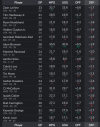
Kevin Love has the worst actual defensive EPM in the entire league. Keyonte, Collier, and WCJ are also near the very bottom of the league here.
The stat does not account for individual player situations, because there doesn't exist a stat on earth that can actually do that. The takeaway, as I've said before, isn't "Oh, the Jazz three point guards are all the worst defenders in the league".
It's, "Oh, the Jazz can't stop anything when Kevin Love is their center".
View attachment 19832
Kevin Love has the worst actual defensive EPM in the entire league. Keyonte, Collier, and WCJ are also near the very bottom of the league here.
The stat does not account for individual player situations, because there doesn't exist a stat on earth that can actually do that. The takeaway, as I've said before, isn't "Oh, the Jazz three point guards are all the worst defenders in the league".
It's, "Oh, the Jazz can't stop anything when Kevin Love is their center".
I was referring pure RAPM in my post, which Keyonte is very last place in. But there’s really no point in fussing over whether or not he’s worst, 5th worst, 10th worst….whatever. It’s very bad.
These numbers do not account for everything perfectly, but they do in fact account for teammate impact. It’s the best way to separate out a player’s impact from his teammates and opponents. If you have an argument as to why DFG% is actually better, I’m all ears.
PS: Having Kevin Love on the roster isn’t actually an argument as to why Key’s RAPM, EPM, etc is so bad. That’s not how these numbers work. In fact, his other numbers like DFG% are more likely to be altered. Again, APM statistics are not perfect but they directly aim to address teammate/opponent influence.
They are HEAVILY driven by on-court +/- relative to off-court +/-, while attempting to hold all else equal. There's 10 other variables that impact these stats. There's roles within teams that impact these stats.I was referring pure RAPM in my post, which Keyonte is very last place in. But there’s really no point in fussing over whether or not he’s worst, 5th worst, 10th worst….whatever. It’s very bad.
These numbers do not account for everything perfectly, but they do in fact account for teammate impact. It’s the best way to separate out a player’s impact from his teammates and opponents.
What they say is that the lineups that Keyonte is in, the lineups that Collier is in, the lineups that WCJ is in, the lineups that Love is in, are all really bad defensively compared to the similar lineups that exclude them individually. People misuse this stat constantly to pretend that if you pluck another player into the same situation, whatever their EPM is from their previous situation would carry over.
Because it's more under Keyonte's control and more correlated with something he is actually doing. It's not a good stat either, but when it comes to what you're trying to use both of these stats for, I'd take that over RAPM easily. You shouldn't be using either really for this purpose though.If you have an argument as to why DFG% is actually better, I’m all ears.
If Love is sharing a significant portion of his minutes with Keyonte relative to other players on the team (he is), they absolutely are a significant part of the argument as to why it's so bad.PS: Having Kevin Love on the roster isn’t actually an argument as to why Key’s RAPM, EPM, etc is so bad. That’s not how these numbers work. In fact, his other numbers like DFG% are more likely to be altered. Again, APM statistics are not perfect but they directly aim to address teammate/opponent influence.
I don't think Keyonte is a good defender, at all, but it'd be nice to keep the conversation grounded in reality instead of misusing the hell out of incredibly noisy metrics.
No, they don't. They compare on-court +/- to off-court +/-. There's 10 other variables that impact these stats. There's roles within teams that impact these stats.
I’m sorry, but that is not how they work. Things like teammate synergy or scheme could affect these numbers, but if you don’t think the numbers address the relative strength of teammates and opponents you are misunderstood. That is the entire point of APM. Ironically, you are arguing in favor of numbers with no teammate adjustment and against numbers with teammate adjustment.
This conversation can’t continue unless you understand what APM is.
Adjusted Plus-Minus (APM) Explained
Adjusted plus-minus accounts for 4 teammates and 5 opposing players' quality on the court. A +1 APM player means an average lineup would score 1 more point per 100 possessions with this player added.
 www.nbastuffer.com

Year 3 Key compares well with year 3 Don and year 5 Brunson on the counting stats and offensive metrics. Interestingly all 3 are within 2.4 points of each other in net on/off impact which is a stat people seem to love these days. All three are major positives on offense, but negatives on defence. Brunson beats both guys handily in some of the other advanced numbers, but thats year 5 (Brunsons age 26 season) vs year 3. (age 22 for Key, age 23 for Don).
Even though the numbers are similar, the situations arent. Key plays for a bad team while Brunson and Mitchell played for 5th and 6th seed teams who were aiming for playoffs and clearly trending upwards in the bigger picture as well. He also has Lauri as his wingman, while Brunson had Randle and Don had Bojan who arent the same caliber guys imo.

Even though the numbers are similar, the situations arent. Key plays for a bad team while Brunson and Mitchell played for 5th and 6th seed teams who were aiming for playoffs and clearly trending upwards in the bigger picture as well. He also has Lauri as his wingman, while Brunson had Randle and Don had Bojan who arent the same caliber guys imo.
Last edited:
No, I understand it quite well.I’m sorry, but that is not how they work. Things like teammate synergy or scheme could affect these numbers, but if you don’t think the numbers address the relative strength of teammates and opponents you are misunderstood. That is the entire point of APM. Ironically, you are arguing in favor of numbers with no teammate adjustment and against numbers with teammate adjustment.
This conversation can’t continue unless you understand what APM is.
Adjusted Plus-Minus (APM) Explained
Adjusted plus-minus accounts for 4 teammates and 5 opposing players' quality on the court. A +1 APM player means an average lineup would score 1 more point per 100 possessions with this player added.
Straight from your link:
A different role, a different coaching scheme, different teammates, different match-ups, or different seasons affect APM big time.
Another issue which adjusted plus-minus technique struggles to address is the multicollinearity issue. Coaches prefer to use some player duos/trios frequently or rarely since all players could not be on the court with every other teammate at the same time.
Anybody who claims that "Having Kevin Love on the roster isn’t actually an argument as to why Key’s RAPM, EPM, etc is so bad", or that " is unfamiliar with the inherent flaws in these stats.