Donald Trump, the "America First" candidate and president, has turned out to be rather hawkish. In less than 12 months in office this second time around, he's conducted strikes in seven countries — Iran, Nigeria, Yemen, Iraq, Syria, Somalia and, this weekend, oversaw a daring middle-of-the-night raid in Venezuela.
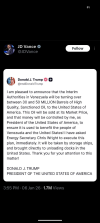
Trump has a long history of saying the United States should "take the oil."
"You're not stealing anything," Trump said of taking oil from Iraq in a 2011 interview with ABC. "We're reimbursing ourselves."
Fast forward to 2023, when Trump was out of office, talking about Venezuela.
"We're buying oil from Venezuela," Trump said during an event in North Carolina. "When I left, Venezuela was ready to collapse. We would have taken it over. We would have gotten all that oil. It would have been right next door. But now we're buying oil from Venezuela"
The White House has repeatedly claimed to be stemming the flow of fentanyl by striking alleged drug boats off the coast of Venezuela, despite the fact that fentanyl isn't largely produced in Venezuela.
Rubio, meanwhile, said that this was a law enforcement action to recover fugitives, because of a 2020 indictment of Maduro for the trafficking of cocaine. That, by the way, seems to be part of the administration's rationale for not seeking authorization from Congress.
These explanations are likely more politically palatable to the MAGA base, than saying the United States is at war with Venezuela or, as Trump said, that the United States is now running another country — with no clear goals for an exit.
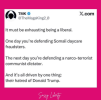
Right-wing authoritarians are OK, but left-wing dictators are not?
Trump referred to Maduro as a "dictator" four times during his news conference Saturday (an "outlaw dictator," "illegitimate dictator," "now-deposed dictator" and "dictator and terrorist.")
But there are lots of other dictators, authoritarians and strongmen in the rest of the world, many of whom Trump has praised through the years.
Trump has allied himself with people like Hungary's Viktor Orbán, Argentina's Javier Milei, rolled out the red carpet for Saudi Arabia's Mohammed bin Salman, seems deferential to Russia's Vladimir Putin, and, during his first term, made overtures to North Korea's Kim Jong Un.
Couldn't there be justifications for those leaders' overthrow, too, that an American administration could come up with, following Trump's logic?
It's not a far leap to suggest the difference is politics (and oil).
They might point out the apparent hypocrisy of ousting Maduro because of drugs while pardoning the former head of Honduras, who was convicted of drug trafficking.
This is the president's most vulnerable point politically in this second term. He is facing his worst approval ratings, is going to be 80 in June and is inching closer to politically irrelevant lame-duck status.
So it might not be surprising that Trump would try to stay in the headlines, like with this Venezuela action, and shift attention away from other, more negative issues for him politically.


 www.enr.com