

Red
Well-Known Member
“We say black is white. Agree, or you are a criminal”.
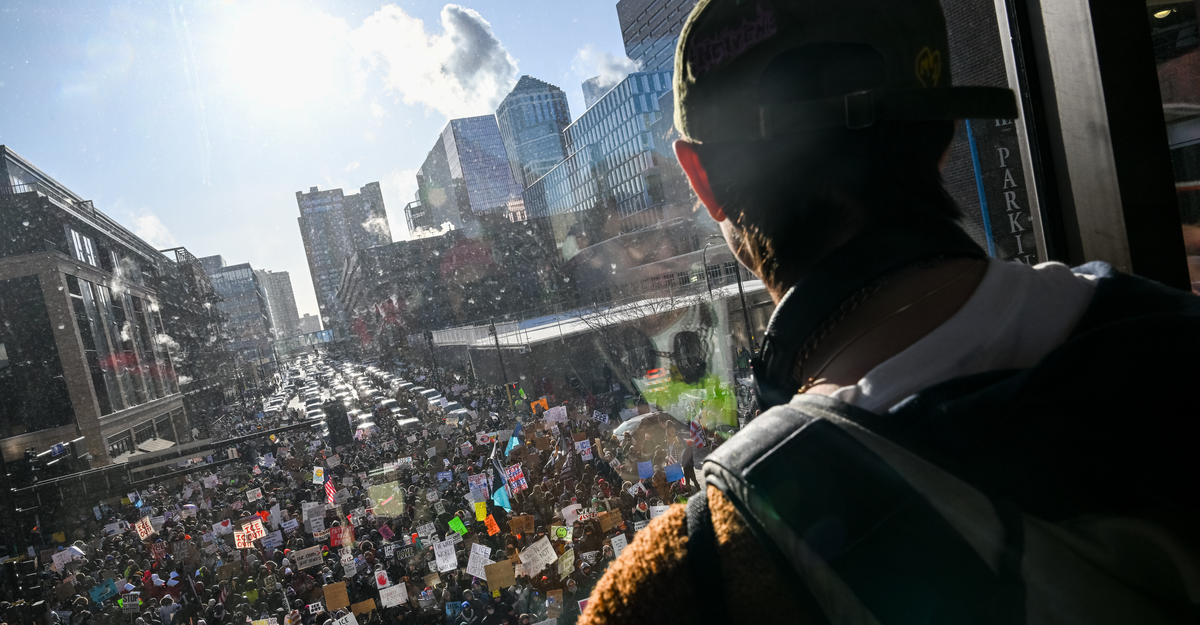
The killings in Minneapolis of Renee Good and Alex Pretti have been compared to the murder of George Floyd, because they all happened within a few miles of one another, and because of the outrage they inspired. There’s an important difference, though: In 2020 the United States was in turmoil, but it was still a state of law. Floyd’s death was followed by investigation, trial, and verdict—by justice. The Minneapolis Police Department was held accountable and ultimately made to reform.
No one should expect justice for Good and Pretti. Today, nothing stands in the way of the brutal tactics of ICE and the Border Patrol. While President Trump seems to be trying to defuse the mayhem he’s caused by reassigning a top commander, he is not withdrawing the federal agents from the state or allowing local authorities to investigate, let alone prosecute, them for their actions.
Authoritarianism doesn’t disappear with the news cycle. The administration’s automatic lies about the killings and slander of the victims are less a cover-up of facts than a display of utter contempt for them. Trump, Secretary of Homeland Security Kristi Noem, FBI Director Kash Patel, and other top officials seem to invite incredulity as a way to flex their power: We say black is white. Agree or you’re a criminal. When Stephen Miller recently claimed that geopolitics is ruled by the “iron laws” of “strength” and “force,” he was expressing the administration’s approach to domestic governance as well. Those words are iron laws on American streets.
The prelude to the violence of January 7 and 24 came not in Minneapolis on May 25, 2020, but in Washington, D.C., on January 6, 2021. Trump and his supporters were prevented from stealing an election and overthrowing the Constitution by democratic institutions—Congress, the courts, the police, the media, and public opinion. But the insurrection never ended. By the time Trump returned to power and pardoned the insurrectionists, almost half of the country believed that January 6 was a patriotic demonstration, a false-flag operation, or just no big deal. Throughout 2025, institutions that once restrained the presidency weakened or fell away one by one, until earlier this month Trump told The New York Times that the only limit to his power is his own mind. That same day, January 7, authoritarianism had its predictable consequence in freezing Minneapolis with the execution of Renee Good.
If rogue federal agents can shoot American citizens dead with total impunity, then it doesn’t matter whether state and local authorities, the courts, the media, the political opposition, and a mobilized public object. “ICE > MN,” Defense Secretary Pete Hegseth wrote on social media—an assertion of raw force, not constitutional authority. When Trump and his loyalists call protesters terrorists and warn that disobeying orders will get you killed, they strip away any illusion that the federal government respects the lives, let alone the rights, of those who oppose it—potentially half the population or more.
A lawless regime is an illegitimate one. If the country seems to have reached a breaking point in Minneapolis, this is why. And yet Minneapolis also offers a compelling answer to the question that democracy-loving Americans have asked for the past year: What can I do?

The killings in Minneapolis of Renee Good and Alex Pretti have been compared to the murder of George Floyd, because they all happened within a few miles of one another, and because of the outrage they inspired. There’s an important difference, though: In 2020 the United States was in turmoil, but it was still a state of law. Floyd’s death was followed by investigation, trial, and verdict—by justice. The Minneapolis Police Department was held accountable and ultimately made to reform.
No one should expect justice for Good and Pretti. Today, nothing stands in the way of the brutal tactics of ICE and the Border Patrol. While President Trump seems to be trying to defuse the mayhem he’s caused by reassigning a top commander, he is not withdrawing the federal agents from the state or allowing local authorities to investigate, let alone prosecute, them for their actions.
Authoritarianism doesn’t disappear with the news cycle. The administration’s automatic lies about the killings and slander of the victims are less a cover-up of facts than a display of utter contempt for them. Trump, Secretary of Homeland Security Kristi Noem, FBI Director Kash Patel, and other top officials seem to invite incredulity as a way to flex their power: We say black is white. Agree or you’re a criminal. When Stephen Miller recently claimed that geopolitics is ruled by the “iron laws” of “strength” and “force,” he was expressing the administration’s approach to domestic governance as well. Those words are iron laws on American streets.
The prelude to the violence of January 7 and 24 came not in Minneapolis on May 25, 2020, but in Washington, D.C., on January 6, 2021. Trump and his supporters were prevented from stealing an election and overthrowing the Constitution by democratic institutions—Congress, the courts, the police, the media, and public opinion. But the insurrection never ended. By the time Trump returned to power and pardoned the insurrectionists, almost half of the country believed that January 6 was a patriotic demonstration, a false-flag operation, or just no big deal. Throughout 2025, institutions that once restrained the presidency weakened or fell away one by one, until earlier this month Trump told The New York Times that the only limit to his power is his own mind. That same day, January 7, authoritarianism had its predictable consequence in freezing Minneapolis with the execution of Renee Good.
If rogue federal agents can shoot American citizens dead with total impunity, then it doesn’t matter whether state and local authorities, the courts, the media, the political opposition, and a mobilized public object. “ICE > MN,” Defense Secretary Pete Hegseth wrote on social media—an assertion of raw force, not constitutional authority. When Trump and his loyalists call protesters terrorists and warn that disobeying orders will get you killed, they strip away any illusion that the federal government respects the lives, let alone the rights, of those who oppose it—potentially half the population or more.
A lawless regime is an illegitimate one. If the country seems to have reached a breaking point in Minneapolis, this is why. And yet Minneapolis also offers a compelling answer to the question that democracy-loving Americans have asked for the past year: What can I do?