What's new

Chess Match Thread

I'd have to take your word for it. Just let me know if you ever beat a world-class program at full strength, and you'll have your money.

Technology is advancing at such a staggering rate, and I'm curious as to how the "human intelligence cannot be replicated" crowd will react as they see computers surpassing human cognitive ability in more and more areas. It is also quite possible you'll live long enough to see computers that cannot be distinguished from humans through conversation. And I'm not talking about programming trickery, like cramming in millions of different answers to most conceivable situations. I am talking about a machine that is capable of formulating responses based on its knowledge and experience independent of any programmed response, and purely based on creative application of its knowledge and experience (like a human). If such a thing comes to pass, would you consider it intelligent? Is there any threshold of intelligence that you'd accept to recognize man-made machines as sentient entities much like humans? Or do you have philosophical/religious reasons to reject that notion regardless of how intelligent a machine appears to be?

Mormons, in terms of "official" statements, have moved away from their originality trying to pass as "Christian", but I don't accept transitional authoritarianism in either religion or government. Few thinkers fully appreciate the radical underpinnings of original Mormonism. . ..

A God that is only "god" because. . .iff....He adheres to truth and virtue, whose place in the Cosmos is earned through willingness to serve others, who also are uncreated eternal individual entities called "intelligences".

Transhumanism is the idea that we can take the place of the "Judeo/Christian" god as rendered later by medieval organized statist religions, which saw man as slaves to the State.

A machine is only a more efficient slave to someone.

The present LDS leadership is compromised as a tool dedicated to statist priorities, officially speaking, but the real American Revolution is destined to re-assert the imperatives of human dignity and human rights, and machines will never be humans.
 
Mormons, in terms of "official" statements, have moved away from their originality trying to pass as "Christian", but I don't accept transitional authoritarianism in either religion or government. Few thinkers fully appreciate the radical underpinnings of original Mormonism. . ..

A God that is only "god" because. . .iff....He adheres to truth and virtue, whose place in the Cosmos is earned through willingness to serve others, who also are uncreated eternal individual entities called "intelligences".

Transhumanism is the idea that we can take the place of the "Judeo/Christian" god as rendered later by medieval organized statist religions, which saw man as slaves to the State.

A machine is only a more efficient slave to someone.

The present LDS leadership is compromised as a tool dedicated to statist priorities, officially speaking, but the real American Revolution is destined to re-assert the imperatives of human dignity and human rights, and machines will never be humans.

I'd like a more direct, and rational, answer to the question; why can't machines be like humans? Your answers often are too dependent on your own internal perspective, and you rarely attempt to use the tools of logic that enables others to understand why you reached a certain conclusion. So let me ask again. If a machine is self-aware, can act and think through its personal experience, as opposed to programmed response, and is ultimately too complex to be perfectly predictable, what makes it less than a human? Keep in mind that the word 'machine' is a convention that we use to describe man-made systems, and not a concept with inherent universal meaning that relates to servitude or anything else.
 
I'd like a more direct, and rational, answer to the question; why can't machines be like humans? Your answers often are too dependent on your own internal perspective, and you rarely attempt to use the tools of logic that enables others to understand why you reached a certain conclusion. So let me ask again. If a machine is self-aware, can act and think through its personal experience, as opposed to programmed response, and is ultimately too complex to be perfectly predictable, what makes it less than a human? Keep in mind that the word 'machine' is a convention that we use to describe man-made systems, and not a concept with inherent universal meaning that relates to servitude or anything else.

What use would there be for "God the Creator" in a world where mankind was capable of creating "Machine People"? If humanity can be recreated without a divine spark then what does that say about the existence of Babe's soul?
 
I'd like a more direct, and rational, answer to the question; why can't machines be like humans? Your answers often are too dependent on your own internal perspective, and you rarely attempt to use the tools of logic that enables others to understand why you reached a certain conclusion. So let me ask again. If a machine is self-aware, can act and think through its personal experience, as opposed to programmed response, and is ultimately too complex to be perfectly predictable, what makes it less than a human? Keep in mind that the word 'machine' is a convention that we use to describe man-made systems, and not a concept with inherent universal meaning that relates to servitude or anything else.

Let's co-author a cutting-edge book on this topic?

A "machine" made by man, when it ages or wears out or malfunctions beyond repair, is only a pile of old parts.

We might not have incomtrovertiblro evidence of our eternal nature with a kind of life both before and after this present existence, but however that may be, it is essential to the idea of inherent human rights that humans are more than machines.

It is essential for any ongoing credibility or relevance to assert thataby "god" we attribute our faith to should actually be in existence, acting on principles that are good and deserving respect.

We humans cannot define God, only approach in understanding what is. Same thing for the universe in general, science or any other format for enquiry. . .thus we should not be unwilling to embrace truth as we may find it.

Saying that prior belief must take precedence appears to meto fail the test of truth. What is true will stand up to better I formation.

I think it is similarly short-sighted to place faith in a present level of understanding.

Ultimately, if humans are the created things of any God", the best we can claim in human rights is "God-given". I claim inherent rights.equal to those of any other human.

A machine we create can only claim "man-given" rights, say those specified by a legislative body or other government-specified "rights".

Transhumanism has been believed by some since before Mary Shelly wrote Frankenstein, asserting that technology can improve upon life, essentially improving on God, and making us better than God

I reject that thesis in preference to the existing God that has brought us thus far and who indeed is moving forward with a better program for human advancement, on virtuous principles that honor our intrinsic human rights.......

Recognizing and respecting our capacity for choice, for virtue, for love and for dreaming and wanting things that arise within our own natures.

Making us far more than machines or programs will ever be. . .

Creating a machine that dreams. . . .hmmmmmm. Who knows. . . .,
 
Let's co-author a cutting-edge book on this topic?

A "machine" made by man, when it ages or wears out or malfunctions beyond repair, is only a pile of old parts.

We might not have incomtrovertiblro evidence of our eternal nature with a kind of life both before and after this present existence, but however that may be, it is essential to the idea of inherent human rights that humans are more than machines.

It is essential for any ongoing credibility or relevance to assert thataby "god" we attribute our faith to should actually be in existence, acting on principles that are good and deserving respect.

We humans cannot define God, only approach in understanding what is. Same thing for the universe in general, science or any other format for enquiry. . .thus we should not be unwilling to embrace truth as we may find it.

Saying that prior belief must take precedence appears to meto fail the test of truth. What is true will stand up to better I formation.

I think it is similarly short-sighted to place faith in a present level of understanding.

Ultimately, if humans are the created things of any God", the best we can claim in human rights is "God-given". I claim inherent rights.equal to those of any other human.

A machine we create can only claim "man-given" rights, say those specified by a legislative body or other government-specified "rights".

Transhumanism has been believed by some since before Mary Shelly wrote Frankenstein, asserting that technology can improve upon life, essentially improving on God, and making us better than God

I reject that thesis in preference to the existing God that has brought us thus far and who indeed is moving forward with a better program for human advancement, on virtuous principles that honor our intrinsic human rights.......

Recognizing and respecting our capacity for choice, for virtue, for love and for dreaming and wanting things that arise within our own natures.

Making us far more than machines or programs will ever be. . .

Creating a machine that dreams. . . .hmmmmmm. Who knows. . . .,

With all due respect, I think you have a narrow view of life and technology. There are two fundamental problems with your thesis. First, technology can undoubtedly improve on our "state of nature". For example, you'd be hard pressed coming up with a reasonable argument for how clothes corrupt our perfect, God given naked form, and that we would be better off without them (in fact, most Christians seem allergic to the naked form). Secondly, and far more importantly as it relates to transhumanism and this discussion, you buy the false notion that technology is somehow outside of nature. That is not so. Language is a communication technology. Writing is another. Both are required for reliably passing along information from one generation to the next. Through the use of these technologies, we profoundly changed our state of nature. Do you oppose using your brain along with writing technology to learn more about the world and improve yourself through that knowledge? Do you oppose using a computer instead of printed text to accomplish the same thing? The point is, any and all technology we create is the product of our natural brain (created by God, if you're a believer). Yet somehow, God intends for us to limit the use of this inexplicably incredible brain only to an arbitrary set of ideas, tools, and techniques? If God gave us the ability to enhance our brains, then why do you see it as affront to God?

The creation of technology is a product of life no different than any other except in the power of its potential. Unlike other non-technological life forms, we possess the ability to transcend the limits of our environment -planet, even- and perhaps our biology. Surely if there is a God he intended for us to utilize what he gave us to its full potential, and surely he did not intend for us to waste it on primitive ideas like the value of stasis and the undesirability of change. Without the desire to change, there is no point at all to intelligence. And without the freedom to become all we can become, we're no more than machines. And God just happens to be the operator.
 
Enes CanTear You Apart;950620]


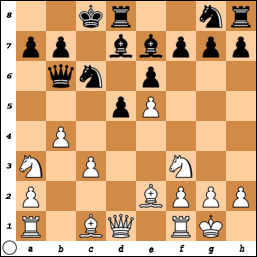
1. e4 e6
2. d4 d5
3. e5 c5
4. c3 Nc6
5. Nf3 Qb6
6. Be2 Be7
7. O-O Bd7
8. dxc5 Bxc5
9. b4 Be7
10. Na3 0-0-0

Thank you for fixing my notation.


1. e4 e6
2. d4 d5
3. e5 c5
4. c3 Nc6
5. Nf3 Qb6
6. Be2 Be7
7. O-O Bd7
8. dxc5 Bxc5
9. b4 Be7
10. Na3 0-0-0
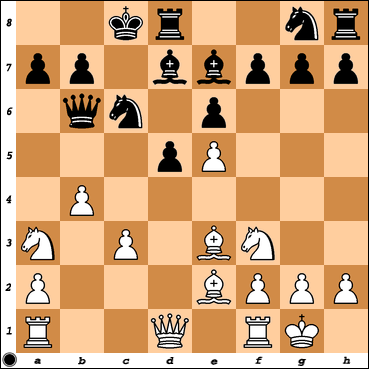
11. Be3

OB, I'm not gonna be around for a week or so, it might be even longer. Wanted to let you know. Thanks for your patience.


As for the recent debate in the thread, this comes from Nakamura, one of the top GMs currently. And he said this early 2011, consider that chess engines these days are much stronger and they are consistently improving algorithmically.

"Computer programs these days are actually stronger than human players, significantly stronger. If I played a computer in a match I would get destroyed, I would be slaughtered, and that's saying something considering where I'm at in the world of chess."

The best thing a GM can do these days against the modern chess engines would be a lucky draw playing white, and that is only if the computer configuration is not so good.
 
With all due respect, I think you have a narrow view of life and technology. There are two fundamental problems with your thesis. First, technology can undoubtedly improve on our "state of nature". For example, you'd be hard pressed coming up with a reasonable argument for how clothes corrupt our perfect, God given naked form, and that we would be better off without them (in fact, most Christians seem allergic to the naked form). Secondly, and far more importantly as it relates to transhumanism and this discussion, you buy the false notion that technology is somehow outside of nature. That is not so. Language is a communication technology. Writing is another. Both are required for reliably passing along information from one generation to the next. Through the use of these technologies, we profoundly changed our state of nature. Do you oppose using your brain along with writing technology to learn more about the world and improve yourself through that knowledge? Do you oppose using a computer instead of printed text to accomplish the same thing? The point is, any and all technology we create is the product of our natural brain (created by God, if you're a believer). Yet somehow, God intends for us to limit the use of this inexplicably incredible brain only to an arbitrary set of ideas, tools, and techniques? If God gave us the ability to enhance our brains, then why do you see it as affront to God?

The creation of technology is a product of life no different than any other except in the power of its potential. Unlike other non-technological life forms, we possess the ability to transcend the limits of our environment -planet, even- and perhaps our biology. Surely if there is a God he intended for us to utilize what he gave us to its full potential, and surely he did not intend for us to waste it on primitive ideas like the value of stasis and the undesirability of change. Without the desire to change, there is no point at all to intelligence. And without the freedom to become all we can become, we're no more than machines. And God just happens to be the operator.

Well, I include bacteria and trees, whatever found in nature that has the necessary elements of respiration, or photosynthesis, or any other energy-based process for conducting the business of metabolism, over some life-span of functionality, and generation of descendants having the same basic characteristics. . . .but hell yeah, I don't include stuff that runs on batteries or plugs into a wall outlet. Even if it can "dream".

Freedom is a loose-cannon concept sometimes. Everything operates on some principle and dependent on some context. Cognition implies a right to respond somehow, intelligence implies a right to "change" things within reach with available tools, inherent or acquired skills or known methods. Being "alive" implies a right to defend one's life and utilize resources in the world around us.

I take a dim view of bioengineering sometimes, particularly genetic engineering because I consider our skills dangerous and even life-threatening in the extreme. We have no clue what the impact will be. It's like giving a babe a loaded gun and laughingly encouraging pointing and pulling the trigger.

Tools that increase our capacity to build or meet needs seem more acceptable, things that can save time and energy and labor seem called for, too. You need to break down your analysis and bring your generalities to a specific point relevant to what I'm saying.

I like a lot of progress, I'm just fussy about some things.

In my discussions with you, I am obliquely responding to a notion that you're a "progressive" sort of brave new world dreamer with a penchant for organized human programs directed by some high-level intellectuals for the good of humanity. Something I think is inherently fascist because it's always money talking and money walking and money calling the tune. . . . meaning a few humans with inordinate power as things are. Colleges and universities are dependent on donations from large-scale businesses and inordinately-wealthy individuals, and there are always some strings attached. . . . So our "intellectuals" at the highest levels tend to be singing their tunes. . . .

I keep singing a different tune, about how decentralized decisions on micro levels have proven themselves in nature more competent to produce a succession of successful adaptations and responses to changes in the world environment and in fact in all the local environments, where we find life forms adapted to the niche. I like the idea of individuals making decisions relevant to their own interests on the most fundamental level of responsibility.

And yes, let's bust the trusts all over again.

And yes, what I'm concerned about is technology controlled by those corporates/cartels/trusts/elites to the exclusion of little ol me. I might have a PC and a chess phone app, but I think I have a problem being outgunned technologically by corporates and their captive government arms.
 
Last edited:


1. e4 e6
2. d4 d5
3. e5 c5
4. c3 Nc6
5. Nf3 Qb6
6. Be2 Be7
7. O-O Bd7
8. dxc5 Bxc5
9. b4 Be7
10. Na3 0-0-0
11. Be3

OB, I'm not gonna be around for a week or so, it might be even longer. Wanted to let you know. Thanks for your patience.


As for the recent debate in the thread, this comes from Nakamura, one of the top GMs currently. And he said this early 2011, consider that chess engines these days are much stronger and they are consistently improving algorithmically.


The best thing a GM can do these days against the modern chess engines would be a lucky draw playing white, and that is only if the computer configuration is not so good.

A Grand Master can still be stupid once in a while. Most of us are often stupid. We just don't think things through carefully enough. It's not that we can not or could not figure things out as well as a computer, we're just too slow to do it inside one lifetime. So, we can write a program that will play chess nearly perfectly. We could also write a program that could analyze the moves made by a computer and print out the algorithm it is following. And then we could write another program that would devise a way to exploit some characteristics of that algorithm and gives us a victory.

Some people have spent years devising those top-ranked algorithms for chess. Might take some years to devise the analytic algorithms and the trickster algorithms as well. Considering the level of talent that's gone into the issue already, and how some computer vs. computer games have turned out, I think my thesis is proved that it's unlikely there is an unbeatable chess algorithm in existence, and maybe even unlikely that one can be produced.

but hey, it's just as likely that it's impossible for me to prove my opinion.
 
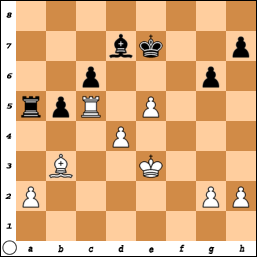
One Brow vs. babe


d7c5rhbvbia9.png


1. d4 d5
2. c4 dxc
3. Nc3 Nf6
4. Nf3 e6
5. Bg5 Be7
6. e3 Nd5
7. Bxe7 Qxe7
8. Bxc4 Qb4
9. Qb3 Qxb3
10. Bxb3 c6
11. 0-0 Nd7
12. Nxd4 exd
13. Rfc1 Nf6
14. Ba4 Bd7
15. b4 b5
16. Bb3 0-0
17. Ne5 Rfc1
18. Rc2 a5
19. bxa Bd8
20. Rac1 Ra6
21. f3 g6
22. Ng4 Kg2
23. Nxf6 Kxf6
24. Bxd5 Ke7
25. Rc5 f5
26. e4 Bd7
27. Bb3 fxe
28. fxe Rf8
29. Rf1 Rxf1
30. Kxf1 Rxa5
31. Kf2 Kd6
32. e5+ Ke7
33. Ke3

I'm sure we'll be trading off our bishops at some point. I'll just have to see if I can get it to happen when I like it.
 
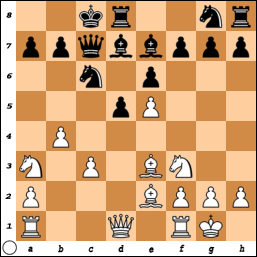
Enes CanTear You Apart vs. One Brow


1. e4 e6
2. d4 d5
3. e5 c5
4. c3 Nc6
5. Nf3 Qb6
6. Be2 Be7
7. O-O Bd7
8. dxc5 Bxc5
9. b4 Be7
10. Na3 0-0-0
11. Be3 Qc2

No hurry on the response, I'm not going anywhere.
 
One Brow vs. babe


d7c5rhbvbia9.png


1. d4 d5
2. c4 dxc
3. Nc3 Nf6
4. Nf3 e6
5. Bg5 Be7
6. e3 Nd5
7. Bxe7 Qxe7
8. Bxc4 Qb4
9. Qb3 Qxb3
10. Bxb3 c6
11. 0-0 Nd7
12. Nxd4 exd
13. Rfc1 Nf6
14. Ba4 Bd7
15. b4 b5
16. Bb3 0-0
17. Ne5 Rfc1
18. Rc2 a5
19. bxa Bd8
20. Rac1 Ra6
21. f3 g6
22. Ng4 Kg2
23. Nxf6 Kxf6
24. Bxd5 Ke7
25. Rc5 f5
26. e4 Bd7
27. Bb3 fxe
28. fxe Rf8
29. Rf1 Rxf1
30. Kxf1 Rxa5
31. Kf2 Kd6
32. e5+ Ke7
33. Ke3

I'm sure we'll be trading off our bishops at some point. I'll just have to see if I can get it to happen when I like it.

Again, your move is the one I have the most trouble with, your "best move". You are ending my temporary positional advantage too quickly. . . .

I'll be back after reviewing the situation all over again. . . .
 
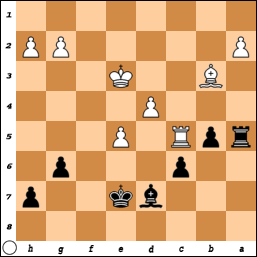
One Brow vs. babe


d7c5rhbvbia9.png


1. d4 d5
2. c4 dxc
3. Nc3 Nf6
4. Nf3 e6
5. Bg5 Be7
6. e3 Nd5
7. Bxe7 Qxe7
8. Bxc4 Qb4
9. Qb3 Qxb3
10. Bxb3 c6
11. 0-0 Nd7
12. Nxd4 exd
13. Rfc1 Nf6
14. Ba4 Bd7
15. b4 b5
16. Bb3 0-0
17. Ne5 Rfc1
18. Rc2 a5
19. bxa Bd8
20. Rac1 Ra6
21. f3 g6
22. Ng4 Kg2
23. Nxf6 Kxf6
24. Bxd5 Ke7
25. Rc5 f5
26. e4 Bd7
27. Bb3 fxe
28. fxe Rf8
29. Rf1 Rxf1
30. Kxf1 Rxa5
31. Kf2 Kd6
32. e5+ Ke7
33. Ke3

I'm sure we'll be trading off our bishops at some point. I'll just have to see if I can get it to happen when I like it.

OK, there were a few interesting options I looked at, but the value of any of them depended upon you suddenly becoming pretty stupid or something. I have to stay as close as I can to a defense.

Honestly, I cannot predict your next move at this point.

Ra6

In case I'm not reading the grid right, that is a move back one square for my Rook, to assist in defense of my pawn and other potential actions on that rank.
 
Back
Top