What's new

Longest Thread Ever

Totalitarian regimes are a phenomenon of the secular "humanist" age.

A little further comment on this claim. . . .

In the medieval Christian states, there was a complex power structure that involved both "secular" state authorities like Kings and nobles, whose support was essential to the system, as well as church authorities like Pope, Archbishops, and priestly orders who had some angles of influence as well. I would not call those governments, as the Holy Roman Empire or the British Empire "totalitarian", particularly as the in the British case, there was a necessity to settle with the commoners and acknowledge people's rights under the Magna Carta.

Most kings before the Middle ages and even during the Middle Ages had a complex power base that precluded arbitrary decisions that had the character of "totalitarian". Even today, Obama with his pen has to respond to bureaucrats in a myriad of federal agencies. Even the Pharoahs of Egypt and folks like Alexander the Great has a social network power base.

So what do we mean by "totalitarian" and "tyrant". In some respects these words share some meaning. Both are commonly thought to be lacking in feedback/input from the subjects/ruled people I think "tyrant" involves a much smaller decision-making base than a "totalitarian" government, perhaps not necessarily a distinction that always applies. A totalitarian government, like our current politician crop is hell-bent on establishing, has a professional base of specialists, a whole horde of public organizations representing various interests, and a set of financially powerful folks who all weigh in on the determination to use government to rule the little folks with absolute authority. All the people who aspire to be the rulers and relevant guiding lights in this kind of authoritarian/totalitarian state believe themselves to be "secular humanists' with superior insights entitling them to take the lead. Some of the players might think they are "religious" with superior insights as well, as some authoritarian religious organizations, such as those who are members of the World Council of Churches, as well. Even Obama has a lot of folks around who might expect him to listen. . . .but his whole crowd all wants the government to be empowered to do whatever they want it to do. . .

A person with a functional conscience who believes people should be respected in any set of natural or innate rights, perhaps "God-given rights", will shrink back from the brink of taking that step of going along with such totalitarian statism.

We have always had tyrants of all kinds of stripes, but only in the past two centuries have we had statists of this kind. Governments claiming to solve all our problems through overwhelming regulation and codification of human behavior without any actual limit of authority. Prior to this age, people had the common expectation of ownership of their property, transmission of their beliefs to their children, and some other personal rights. . . like choosing their doctor if there were any around. . . . . and there was no "Department of Education" that was so thorough in regimenting acceptable ideas. . . .
 
I like it being praised and treated nice. . . .

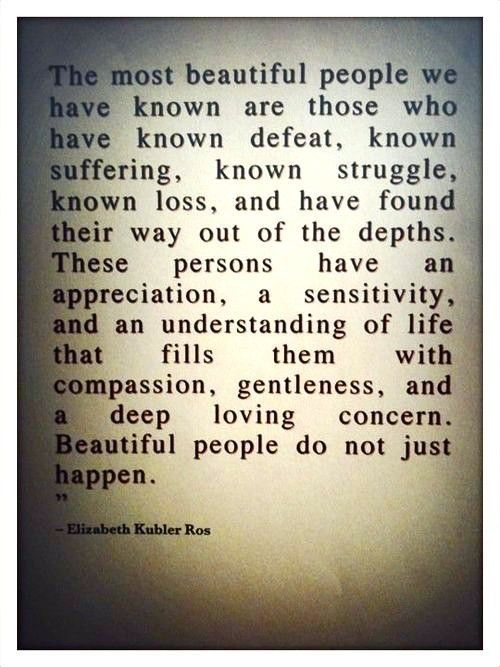
When you speak of "beauty". . . . or when I speak of "beauty", I understand it is a sort of thing that exists in the eye of the beholder.

That's why I can honestly, objectively, and factually tell my daughters and my wife that they are the most beautiful girls in the world. I am the one relevant judge of "beauty" so far I care to discuss the subject. . . .

you are also privileged to define such truths for yourself. . . .

I speak only for myself and it ain't a superficial beauty I'm talking about.

beautifulpeople_zps94e93939.jpg
 
I thought it was funny they called me, for sure. I know they know who I am.

We were at a Trib subscription booth at the State Fair last fall, and "Anthony" was there. He was a very sociable, friendly fellow until I told him I was the famous "babe" of Tribtalk. . . . That was a hoot too. . . .

The last time I saw a persons demeanor change like that was when I was in the Arab quarter of Jerusalem and was lunatic enough to tell the arab souvenir vendor my friend was Jewish. . . . I guess buying a hundred bucks worth of olive wood camels, wise men, and mangers isn't enough to buy the lasting friendship of a Palestinian.

What is really funny is that, after my friend fled for his life, I wandered over to the ancient graveyard, all by myself, and the Palestinian caretaker came to ask me what I was doing.. . . . well, sort of. . . . after a few preliminary questions, he wanted to know if I was married, or more specifically, if I want a little gay thing with him. . . . and this time I had to run for my life. . . .

Awkward!

funny-awkward-moments-sandwhiches.jpg
 
Define "Secular Humanism" to your best ability, and to your actual belief.

Then expect me to respond by showing how various twentieth century despots have invoked these ideas in their statist rule.

I am supposed to be surprised that any ideas could be invoked, sometimes in contradictory fashions, to evil ends? I made no claim that humanistic goals were immune to such use. I only objected to your claim that religious ideals would tend to scale back the excesses of tyranny, when in fact they are often used to support them.
 
Prior to this age, people had the common expectation of ownership of their property, transmission of their beliefs to their children, and some other personal rights. . . like choosing their doctor if there were any around. . . . . and there was no "Department of Education" that was so thorough in regimenting acceptable ideas. . . .

Prior to this age, most people accepted they would never qualify to own their land, and that their transmitted beliefs would be subject to correction if they deviated too greatly from the prevailing religion. The current inability to choose doctors is a feature of private health insurance, not government insurance. Some ideas are in fact mis-education, and deserve to be regimented out.
 
Prior to this age, most people accepted they would never qualify to own their land, and that their transmitted beliefs would be subject to correction if they deviated too greatly from the prevailing religion. The current inability to choose doctors is a feature of private health insurance, not government insurance. Some ideas are in fact mis-education, and deserve to be regimented out.

Clearly, this is a notion of a Secular Humanist that has its corollaries in most other authoritative educational agendas.

It is the justification for all propaganda, all indoctrination, all regimentation, and it presumes, in the heart and mind of the "authorities" a clear claim to being the one who is, ultimately, in the right.

A good educator, in my view, would be content to evaluate different "ideas" using different tools of logic, reason, fact and/or evidence, and leave it to the student to discern the value, the impact, the moral aspects, or utility of the idea. . . . .

And yes, I do believe there are things that are "right" in my views, I have found them essentially on my own, and I realize that anyone else who would understand their rightness, would need to follow a comparable path, a personal journey in their own minds, to come to the same belief. . . .

Socrates was a fine teacher, in my opinion.
 
Prior to this age, most people accepted they would never qualify to own their land, and that their transmitted beliefs would be subject to correction if they deviated too greatly from the prevailing religion. The current inability to choose doctors is a feature of private health insurance, not government insurance.[/I] Some ideas are in fact mis-education, and deserve to be regimented out.


I get it that you view the real goal for national health care is the single-payer, government plan. But the ability to choose a doctor requires a supply of doctors marginally in excess of demand for their services, otherwise you can't get an appointment. Most single-payer government health systems don't motivate enough people to become doctors or put up with all the bureaucratic nonsense, or pay them enough to make putting up with their patients a happy thing.

I know it is the intention of our national planners to lay the blame on the big bad private insurers, and nobody really likes them to begin with. They are the illegitimate spawn of bankers anyhow, in the estimation of most folks who are not the owners or employees of those companies. However, the current unaffordable care system is not entirely their fault, though they sat at the table when the legislation was written. If they thought they could really win in the government casino, they were fools for rolling the dice.

Still, I'd rather have the choice of hiring an insurer to manage my risks than do without their service. I would favor less regulation in that market. . . . maybe just legal enforcement of their contracts in the courts, with some good tort lawyers working their rackets.
 
I am supposed to be surprised that any ideas could be invoked, sometimes in contradictory fashions, to evil ends? I made no claim that humanistic goals were immune to such use. I only objected to your claim that religious ideals would tend to scale back the excesses of tyranny, when in fact they are often used to support them.

My only point here is exactly this. . . said better by you than I have done.

In my general theory of human behavior, any convenient raft of ideas will be pressed into service by those who need to work the masses for their own purposes. . . .

I see no sense in making "religion" or a specific notion of "God" out as "proved evil" because it has been used wrongly. I don't blame God for people's notions of "God" generally. . . most likely none of, or few of, us have understood whatever "God" is. . . . well, at least, I would like to understand better, somehow, someday. . . . .
 
I am supposed to be surprised that any ideas could be invoked, sometimes in contradictory fashions, to evil ends? I made no claim that humanistic goals were immune to such use. I only objected to your claim that religious ideals would tend to scale back the excesses of tyranny, when in fact they are often used to support them.

So my claim is, more specifically, that having a belief in a higher authority, some kind of God who will judge our actions, is a check against excesses the believer might otherwise be prone to. Believing in God, if it generates a sense of "conscience" proscribing specified wrong behaviors, in the mind of a tyrant who has no other limiting force operating in his decision-making.

In your system, as a secular humanist, you can choose your own set of values and be guided by them just as well, if you care to.

I've been thinking about Henry VIII as a model of my theory. . . . . hardly a paragon of virtue in the eyes of most of us. . . . he was a tyrant who could and did just run through the people in his life much like Stalin did, for perhaps different reasons. He was willing to burn "heretics" for even having a Bible, and he found it convenient to just assume the ecclesiastical authority over his nation as well. But in viewing some (two) DVD movies on his life and times, I see his actual belief in God acting as a check against his impulses throughout his life. . . . he had to do a lot of mental gymnastics to make his course seem right in his own mind, and I view that "necessity" as an impediment which Stalin, Mao, or Pol Pot, Hitler. . . .and a lot of others. . . have lacked, believing as they did that there was no God nor any relevant "Judge" whose views they needed to try to take into account. . . .
 
A good educator, in my view, would be content to evaluate different "ideas" using different tools of logic, reason, fact and/or evidence, and leave it to the student to discern the value, the impact, the moral aspects, or utility of the idea. . . . .

At the collegiate level, absolutely. At the elementary level, I disagree strongly. Socrates was a fine teacher of adults.
 
Still, I'd rather have the choice of hiring an insurer to manage my risks than do without their service. I would favor less regulation in that market. . . . maybe just legal enforcement of their contracts in the courts, with some good tort lawyers working their rackets.

Health insurance is unlike any other sort of insurance. A truly free market would be unsustainable for anything but catastrophic insurance. This is why you see a much freer market for auto insurance than for health insurance.
 
In your system, as a secular humanist, you can choose your own set of values and be guided by them just as well, if you care to.

But in viewing some (two) DVD movies on his life and times, I see his actual belief in God acting as a check against his impulses throughout his life. . . .

I don't see belief in God as being a force for evil, nor a force for good. As a believer, you can still choose your own set of values and be guided by them just as well, if you care to. You just assign them to being what God wants.

Also, I really hope you're not putting serious stock into the depiction of a historical figure portrayed by a media that is itself a product of a highly religious country, with the usual bias of the positive effects of religion.
 
Back
Top