What's new

Coronavirus

Natural immunity means that you already have to have been sick.
Yes. @Douchebag K is arguing that people who have already been sick don't need the vaccine, I am arguing that it is proper to expect them to take it even after having been sick. Both of us support immunization for those who have not had covid19. The former is certainly a closer call than the latter.
 
Large enough that you still cut your chance of reinfection in half. Large enough that you have a significantly reduced viral output if you do get the disease again.


Projection.


When you can show it is, I'll gladly face up to it. There is nothing better than learning something new. Take those numbers and show me how I've misinterpreted them, and I'll learn something new. It's a win-win for me.


so .. please explain to me what figures you are using to suggest that you have reduced your risk of reinfection by half ??? In the plainest simple numbers you can.

for example if you have a disease you have a 2 in 1000 chance of contracting and you take a medication that may in a sample see a 1 in 1000 chance of contraction .. i'm guessing you see that as a doubling / halving of the odds yes ?? Do you really think that a 0.001 % chance in statistically significant to a 0.002 % chance ?? And do you account for different age groups which is the key factor ?? I've repeatedly said that if you are of a certain age, health status, weight then sure consider your need for vaccination. Dont see how there is a basis to "expect" a young healthy person to take an additional vaccine, that decision should be weighed up between them and their doctor.

I also think you're now being a bit loose with the term "immunized" given the success rate of such vaccine. It really is more like a therapeutic agent at this stage.
 
Natural immunity means that you already have to have been sick. Natural immunity is just fine. But if the goal is to not risk death in the first place, natural immunity for a person who doesn't already have it is the absolute worst option possible by infinity.

Since the vaccine is extraordinarily safe and has varying effectiveness against different strains, but reduces risk of infection, severity of infection, and possibility of retransmission vs all strains, it is the best possible option for everyone, including people who have natural immunity already.

So yay for people who have had COVID and didn't die. Good for them. They should probably still get the vaccine and all recommended boosters.

Making comments about how the vaccine doesn't do anything, or doesn't stop infection, is intentional misleading and is clearly agenda driven.

Dude if you stopped foaming at the mouth and tried thinking you'd realise you're not even arguing about the same thing as i've been talking about. The vaccine is pretty safe, but again there is no medium to long term safety data, it is literally still under emergency provision with data being collected in real time, the manufacturer is protected against legal action from side effects and there are some infrequent but serious reactions. There is little to no data on what repeated boosters may or may not do to your body's immune system.

The vaccine isn't the "best possible" option for everyone, young healthy non-overweight people who've previously had Covid have almost nothing to be gained and do run a slight but well established risk of vaccine injury. Unwell people, people over a certain age, people overweight with metabolic compromise absolutely should. It's called individualised medical care, risk / benefit analysis by your doctor.

What agenda are you on about ??
 
Yes. @Douchebag K is arguing that people who have already been sick don't need the vaccine, I am arguing that it is proper to expect them to take it even after having been sick. Both of us support immunization for those who have not had covid19. The former is certainly a closer call than the latter.
The woman I know who lost her husband to COVID, before a vaccine was available, also had COVID at that time. She has MS, so you might have worried more about her than her husband (I was since she's the person I've known since I was 2) but she did alright. She got the vaccine and then some time later got COVID, just a few weeks ago. She had a mild case for a second time.
Dude if you stopped foaming at the mouth and tried thinking you'd realise you're not even arguing about the same thing as i've been talking about. The vaccine is pretty safe, but again there is no medium to long term safety data, it is literally still under emergency provision with data being collected in real time, the manufacturer is protected against legal action from side effects and there are some infrequent but serious reactions. There is little to no data on what repeated boosters may or may not do to your body's immune system.

The vaccine isn't the "best possible" option for everyone, young healthy non-overweight people who've previously had Covid have almost nothing to be gained and do run a slight but well established risk of vaccine injury. Unwell people, people over a certain age, people overweight with metabolic compromise absolutely should. It's called individualised medical care, risk / benefit analysis by your doctor.

What agenda are you on about ??
The vaccine is the best possible option. No foam in mouth.
 
The woman I know who lost her husband to COVID, before a vaccine was available, also had COVID at that time. She has MS, so you might have worried more about her than her husband (I was since she's the person I've known since I was 2) but she did alright. She got the vaccine and then some time later got COVID, just a few weeks ago. She had a mild case for a second time.

The vaccine is the best possible option. No foam in mouth.
You know what could’ve helped you not foam from the mouth? A rabies vaccine. Vaccines are really cool things that have arguably been the most significant development for humanity over the last 100 years. Cmon dude, stop foaming at the mouth and get vaccinated!
 
The woman I know who lost her husband to COVID, before a vaccine was available, also had COVID at that time. She has MS, so you might have worried more about her than her husband (I was since she's the person I've known since I was 2) but she did alright. She got the vaccine and then some time later got COVID, just a few weeks ago. She had a mild case for a second time.

The vaccine is the best possible option. No foam in mouth.

I’m real glad your friend pulled through and very sort to hear about her husband. Vaccination was totally the right decision for her
 
so .. please explain to me what figures you are using to suggest that you have reduced your risk of reinfection by half ??? In the plainest simple numbers you can.
I had seen it on the CDC website earlier that day, but can't find the page now.

for example if you have a disease you have a 2 in 1000 chance of contracting and you take a medication that may in a sample see a 1 in 1000 chance of contraction .. i'm guessing you see that as a doubling / halving of the odds yes ?? Do you really think that a 0.001 % chance in statistically significant to a 0.002 % chance ??
1 in 1000 is a 0.1% chance.

What are the numbers?

Through February 13, 2022, there have been 194,350 cases of reinfection, which represents about 4.0% of all COVID infections reported to date in the State.

163,811 of these reinfections have occurred since the week of Dec 13, 2021, the week that variants sequenced in New York State increased to 20% Omicron. This corresponds to 84.3% of reinfections reported in the State to date.
While I don't know how this translates to a wider region, that's ust over 4% of people who got infected getting reinfected, and omicron is making those numbers go up.

A reduction from 4% to even 3% seems worthwhile.

I also think you're now being a bit loose with the term "immunized" given the success rate of such vaccine. It really is more like a therapeutic agent at this stage.
We've been using the same term for the flu vaccine for years.
 
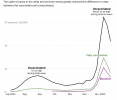
What makes the difference between a therapeutic and a vaccine? It's my understanding that while the vaccines were less effective against omicron infection, they were still pretty good at preventing infection. Above 50 percent effective:

Screen Shot 2022-02-23 at 9.16.58 AM.png
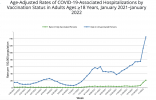
And still far better than any therapeutic/alt treatment against hospitalization:

Screen Shot 2022-02-23 at 9.12.41 AM.png


So at what rate does the vaccine become a therapeutic rather than an immunization? Once it drops below 50 percent effectiveness at preventing an infection? Or does it depend on how ineffective the alt therapeutic treatments are?
 
What makes the difference between a therapeutic and a vaccine?
One is given before an infection and the other is given after an infection. A therapeutic is something you give someone to help them recover from an infection after they've become infected while a vaccine is preventative and given before an infection. It has nothing to do with effectiveness rates.
 
I had seen it on the CDC website earlier that day, but can't find the page now.


1 in 1000 is a 0.1% chance.


While I don't know how this translates to a wider region, that's ust over 4% of people who got infected getting reinfected, and omicron is making those numbers go up.

A reduction from 4% to even 3% seems worthwhile.


We've been using the same term for the flu vaccine for years.


and what percentage of that difference between 3 and 4 % were in which age groups, vulnerability category, in the presence of how many comorbidities etc etc ? You're reaching in a ridiculous way in terms of expecting that to be the "proper" thing to expect everyone to have a booster post infection. Again if you're over around 40 but more specifically diabetic, overweight, old and frail ya for sure get another jab. Young and healthy ?? Pretty pointless other than increasing your risk of an adverse reaction.
 
I worded that wrong meant to say they said they don’t help, but then said they do help.
Moved to a more on-topic thread.

The CDC has been pretty consistent about masks helping to varying degrees since April/May 2020. As new evidence has come in and supply chains have adjusted, they have upgraded or downgraded the desirability of certain types of masks. That's what they should be doing.
 
and what percentage of that difference between 3 and 4 % were in which age groups, vulnerability category, in the presence of how many comorbidities etc etc ?
I certainly don't have an answer to those questions. Do you?

You know who has a keen interest in these questions about the dangers of reinfection when applied to professional athletes, and in forming a reasonable policy based on the best medical and PR decisions? Sports leagues. So far, you've given very general objections in a numbers-light commentary, and I've responded with very general notions in a numbers-light commentary. However, if you really expect me to research the specifics of this, why don't you start?

Young and healthy ?? Pretty pointless other than increasing your risk of an adverse reaction.
What are the numbers supporting this claim? What's their source? In particular, show that the risk from an adverse reaction is greater than the risk from re-infection.
 
Back
Top